Join our network to receive updates on local events and exclusive stories about failure and growth.
You're now part of our global community! You'll be the first to receive updates about upcoming events near you, delivered straight to your inbox. Plus, you'll get access to our special selection of the best failure stories of the month.
Oops! Something went wrong while submitting the form.
FastCompany: Failure Has Never Been More Successful
In 42 cities around the world founders are meeting monthly to share their biggest screw-ups. Should you join them?
By:
FastCompany
Through Fuckup Nights , and other storytelling platforms, people are sharing stories of business disasters like never before.
BY CAMILLE DIANE VON KAENEL
For most entrepreneurs, a $10,000 typo isn’t something to brag about. But when One Hope Wine co-founder Brandon Hall told an audience of 150 young startup enthusiasts about the costly misprint—his first batch of labels read “chardannay”—the crowd laughed and applauded.
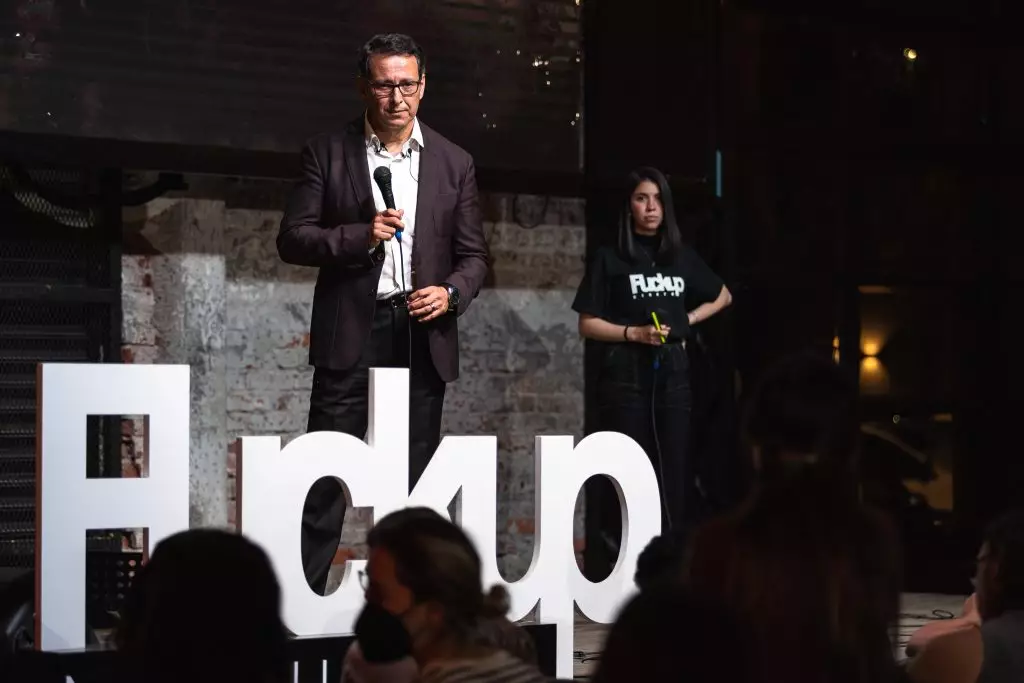
These days, failure is just as much something to brag about as success. The story about the wine came up at the first New York edition of Fuckup Nights, an event celebrating startup screw-ups, in early October. Participants in these gatherings call themselves “fuckupreneurs,” and their numbers are growing.
Fuckup Nights It all began two years ago in Mexico City when a group of friends came up with the idea while drinking mescal. Now, the meetings are held every month in 50 cities on five continents, ranging from Geneva to Melbourne to Quito. And the event organizers expect them to expand to 23 more cities—including Montreal, Nairobi , and (last but not least) San Francisco—in the coming months.
“It’s not usually a question people want to be asking when they talk about their company at cocktail networking events,” admitted Hall, the wine company’s co-founder, when asked about failure.
Yet most startups don’t end up becoming the next Facebook, and founders know that. A frequently cited study by Sikhar Gosh of Harvard Business School puts the startup failure rate at around 75%, but other estimates range from 30% to over 90%.
To stop sugarcoating success, several instances of failure have emerged in recent years. For example, tech entrepreneurs have held three group startup funerals this year in New York City, complete with bagpipers, PowerPoint presentations, and a DJ party. There is also FailCon, a conference celebrating business failure launched by a group in California in 2009. More than a dozen cities around the world—from Tokyo to Tehran to Dubai —now also host local FailCons.
Now, spinning failures into successes—using words like “experience,” “post-mortem analysis,” or “silver lining”—is even becoming mainstream. So mainstream, in fact, that the founder of FailCon recently told the New York that she will shut it down and revamp it next year as a smaller, invitation-only event focused on failure.
Fuckup Nights s themselves almost have the feel of an Alcoholics Anonymous meeting: attendees have accepted failure to varying degrees, ranging from outright denial to enthusiastic embrace. With booze-infused sorbets and tacos, the organizers hoped to convince everyone to turn their darkest moments into bragging rights.
The audience members, dressed in business casual attire and holding out their business cards, were mostly young—too young to have failed, or even started a business, yet. Some didn’t realize the event focused on failure. In front of them at the podium, veteran entrepreneurs spoke for a few minutes about their failed ventures or their business mistakes. One New York speaker, Scott Goodson of the advertising agency Strawberry Frog, stumbled when asked by an audience member how to overcome a failed business. He said he didn’t know because he didn’t consider any of his ventures to be failures.
“The word ‘failure’ alone carries a lot of negative connotations,” admitted Steffan Bankier, a co-organizer of the New York Fuck-Up Nights and a co-founder of the boxed wine company Public House Wine. “I wish there were another word we could use, because learning from a real screw-up is actually very valuable, so it’s not really a failure.”
In fact, the events aim to do just that: turn mistakes into lessons for a younger generation.
The organizers of Fuck-Up Nights have compiled a rich and growing collection of stories about failure. For example, one Mexican entrepreneur opened a sushi restaurant where diners could play video games, but knew nothing about either sushi or video games and eventually gave up on the business. Others mismanaged their finances, trusted unreliable employees, or expanded too soon and too quickly.
The Fuck-Up Nights team has since collaborated with business schools in Mexico to identify the most common causes of startup failure. They plan to expand their research to other countries soon.
But sometimes, simply sharing stories of failure during these events can have a profound impact. For example, Leticia Grasca, a co-founder of Fuck-Up Nights, fondly recalled the talk given by Luis Cabrera, the co-founder of the Mexican branch of the startup incubator Unreasonable Institute. He was speaking publicly about his failures for the first time at a Fuck-Up Night when he suddenly paused.
“He said, ‘I’m sorry, I just realized I was wrong. I’m the one who messed up,’” Grasca recalled. “In the end, he said it had been like an exorcism.”
Seven years ago, Gasca was reviewing a spreadsheet that tracked the finances of her startup, which sold handicrafts made by indigenous women.
“The numbers were all in the red, and I was thinking, ‘I should probably ask my mother for money, I should probably sell my car,’” she said. “And I had to face reality and admit that we had already failed.”
She closed the business and told the women she had become friends with that it was all her fault.
Gasca shared her own story of failure with the confidence of someone who has publicly discussed her deepest mistakes many times over. That’s part of the dynamic of events like Fuck Up Night: what were likely terrible moments are becoming a way to demonstrate experience and knowledge.
Gasca now signs her emails “Failure Sensei,” a reference to the Japanese word for teacher, and works full-time at Fuckup Nights . She keeps busy handling requests from entrepreneurs who want to launch “ Fuckup Nights ” in their own cities and fixing some of the events’ own mishaps. She has dealt with lost projectors and speakers who didn’t show up, she said, but no major failures yet. “But I’m ’m sure it will happen,” she added. “And when it does, we’ll be open and transparent and share it with our community.”








.svg)

.webp)

.png)