Join our network to receive updates on local events and exclusive stories about failure and growth.
You're now part of our global community! You'll be the first to receive updates about upcoming events near you, delivered straight to your inbox. Plus, you'll get access to our special selection of the best failure stories of the month.
Oops! Something went wrong while submitting the form.
There will be no carrot for anyone until there is a carrot for everyone.
By:
Brian Majlin
Carrots for the Few: A Chronicle of Successful Failures in Argentina.
By Brian Majlin *
The “ Fuckup Nights ” began, like almost everything else in this world, as a group of friends—in this case, five of them in Mexico in 2012—talking among themselves about their daily struggles and obsessions. The experience of collective catharsis—as anyone who has ever attended group therapy knows, whether for an addiction, a mental disorder, or an eating disorder—is both effective and dramatic: it gives the sense of not being alone and of being part of a whole governed by a logic that transcends us. This perspective—which frames our lives and problems as both individual and, at the same time, collective and unmanageable—makes them tolerable. It’s reassuring and offers hope.
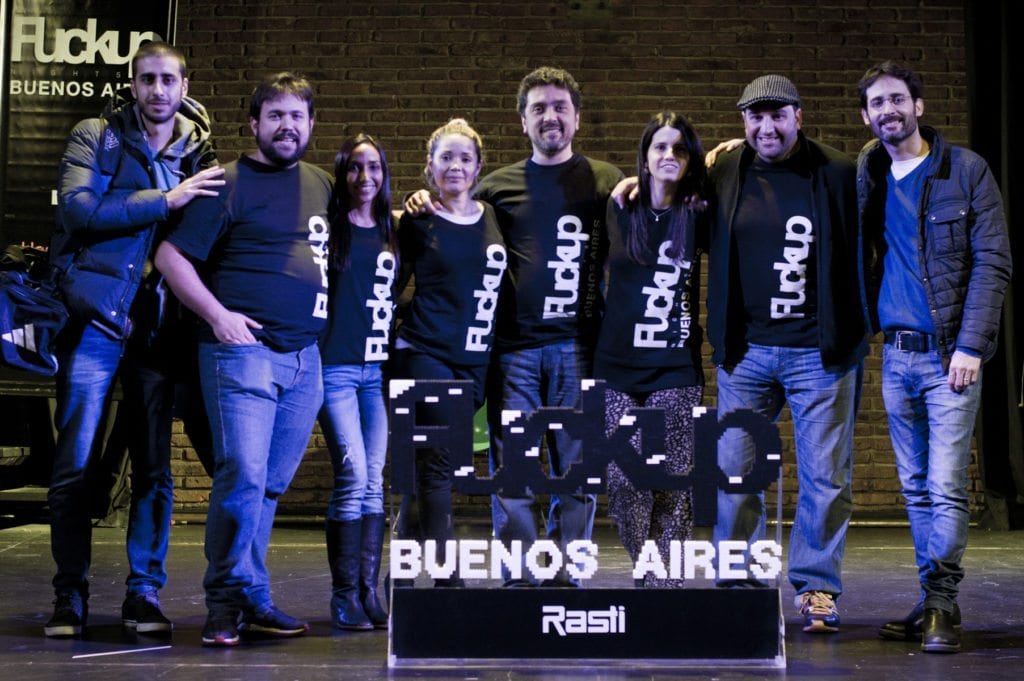
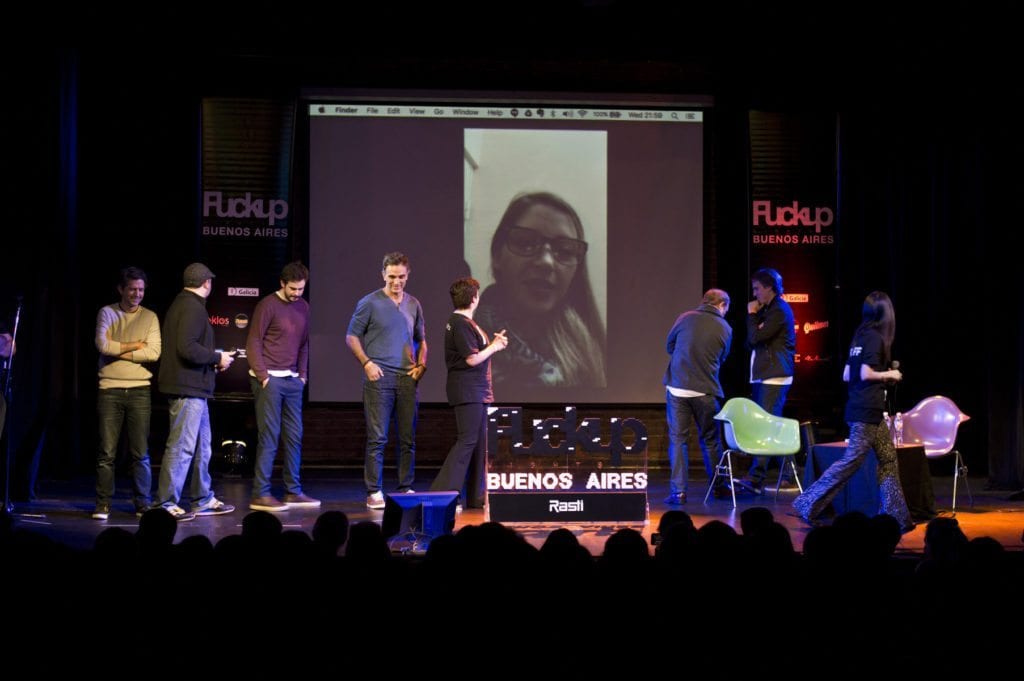
Most motivational talks are based on this premise; while they’re nothing new historically, they’ve been revitalized as the latest trend at a time when concepts like failure and success—always viewed from an individual perspective but largely defined by culturally and socially cultivated standards—guide each person’s life path. Fuckup Nights is no exception, and its sixth edition in Buenos Aires—on Wednesday, July 6, on the fourth floor of the San Martín Cultural Center—confirms the enduring power of its impact: those in attendance—and the speakers—step outside their personal worlds and feel part of something greater.
The music sets the mood, a screen, the lights on the stage, and the audience in staggered seating. The atmosphere is festive and expectant, but nothing like a flop. It’s no surprise that one of the sponsors, in addition to Banco Galicia and Cerveza Quilmes, is Rasti, the Argentine family-owned company that has been successful for decades selling building blocks for kids. The Argentine Legos.
The Enrique Muiño Hall at the CCGSM welcomes those who come to drink in a dose of hope—a pat on the back—with an inspiring quote from Thomas Alva Edison on the importance of trying, despite failure.
The first speaker—and co-organizer and co-producer—of the evening in Buenos Aires is Hernán Schuster, who kicks things off and explains what will happen: the event is designed to be cathartic and features four successful entrepreneurs who will explain when, how much, and how they failed before achieving that success. In every case, success means a thriving business.
There are many new faces, as well as people who have already participated in this event. This occasion also has a spirit of solidarity: attendees take away ideas and inspiration and, in exchange, donate non-perishable food items to the La Vereda de Enfrente Association, which provides assistance in Villa 21.24 in Buenos Aires.
The moderator is Johnatan Loidi, a lecturer and director of the marketing program—which he distinguishes from “Garketing” and “Marquetín,” terms he considers misnomers—at the Catholic University of La Plata. An expert on entrepreneurship and success, he also uses his natural charisma to guide the evening and steer the questions to a successful conclusion.
Just before the first “successful failure,” there’s time for a nonpartisan advocacy segment: a member of the Argentine Entrepreneurs Association (ASEA) explains the importance of embracing failure in this success-obsessed society and the need for an organization that brings entrepreneurs together in the challenging world of entrepreneurship: In August 2016, a bill will be debated in Congress that, he says, will make things easier for entrepreneurs, from financial to bureaucratic matters. And he asks—like any advocate—that they join him, that they not leave him alone, and that thousands of people first join the association and then urge lawmakers to pass that bill.
After a round of applause, the first winner who has learned to lose takes the stage: Tito Loizeau, who 15 years ago surprised Mattel International with the idea of creating the Barbie Store, whose initial wild success ended in crisis and closure just under a year ago. He’ll say that his “honest confession is failure” and that he alone is responsible for that outcome because he delegated his stores too quickly. And he says his problem lay in not following his passion for communication: as a child he made magazines, but he became a Certified Public Accountant first and then an entrepreneur purely out of his father’s mandate and fear.
After a string of minor failures and the success of the Barbie Store, he realized he liked dreaming up projects and bringing them to life, but not sustaining them: he didn’t want to be inside the store with the golden dolls. It’s a good story, and like every good story, it has a moral:
“Passion doesn’t guarantee success, but a lack of passion certainly guarantees failure.”
Next to take the stage is Pamela Scheurer from Jujuy, whose place of birth would be irrelevant were it not for the driving force behind her startup: proving that Jujuy bring added value to the world. Nubimetrics is one of the first three startups in which Telefónica and Mercado Libre invested. She and her partner—and future husband—are alumni of the accelerator programs run by Wayra.
Their failure was mild, almost bland: the project was solid and they had a long list of waiting customers, but the interface was complicated and they had to start from scratch. Anxiety and overwork had them on a path of poor eating and poor sleeping, so a meeting with a mentor, Miguel Sampedro, was their turning point. Like Miyagi, he disciplined them into a healthy lifestyle. The moral of the story is age-old: “Entrepreneurship isn’t a 100-meter dash but a triathlon.” A healthy mind in a healthy body.
Pamela earns some applause, and the empathy of those whose own failures have led them to a life far removed from well-being. Next up is Leo Piccioli, formerly of Officenet and currently at Staples.
His failure is business-related and carries a transnational lesson: he wanted to run Officenet’s Brazilian office his way and says he failed because he didn’t understand the local idiosyncrasies. Although his separation from his wife and the lack of closeness with his two teenage sons today seem to have been the heaviest failure. “I thought I was a hero and I lacked humility,” he’ll say. In 2013, he got his chance at redemption: Staples brought him on board for its Brazilian office, and he is now a resounding success. The moral of the story? Of course:
“Let’s stop thinking of it as failure: it’s either success or a learning experience—you always come away with something.”
To round out the evening, here’s the most famous story. Some time ago, a young entrepreneur who made shoes wrote to Mauricio Macri, the president, to suggest that he wear Argentine shoes—the ones he made. Gastón Greco had a classic 21st-century moment of fame: fleeting, viral, and spreading from social media to traditional media. It was a one-hit wonder, for now, but it was enough for his desperate attempt to make shoes to finally become a profitable business.
The story of this man from Chaco, who masterfully embodies the concept of the empathetic storyteller and the art of oral storytelling with a humorous punchline—a hallmark of stand-up comedy, a genre closely related to motivational talks—draws laughter and applause. He garners empathy from the very start: a serial failure of a father, “more of a spendthrift than an entrepreneur,” who has opened bars, pizzerias, laundromats, and more.
Greco attributed his failure to the lack of—or poor—guidance from his upbringing, but—and no motivational speech is complete without a “but”—the turning point came: from sleeping next to the sewing machine at home, through failed businesses, scams, and mistakes of every kind, to success and the presidential endorsement that highlighted his moral: “I always cursed my old man for his parenting, but in reality, he’s the one who instilled that entrepreneurial spirit in me and took away my fear.”
Final moral: we are social beings, fictitiously isolated, chasing success like a rabbit chases a carrot, and there will be no carrot for anyone until there is a carrot for everyone.
* Brian Majlin (1984) is an Argentine political scientist, journalist, and writer. He contributes to Distintas Latitudes.












.svg)

.webp)


.png)



.avif)

