Join our network to receive updates on local events and exclusive stories about failure and growth.
You're now part of our global community! You'll be the first to receive updates about upcoming events near you, delivered straight to your inbox. Plus, you'll get access to our special selection of the best failure stories of the month.
Oops! Something went wrong while submitting the form.
Fail mindfully: Why I decided to talk about it at TED
Failing fast is a great way to accelerate learning, however, we are promoting mediocrity and minimizing the devastating consequences of failure.
By:
Leti Gasca
Hey, we've officially "made it"
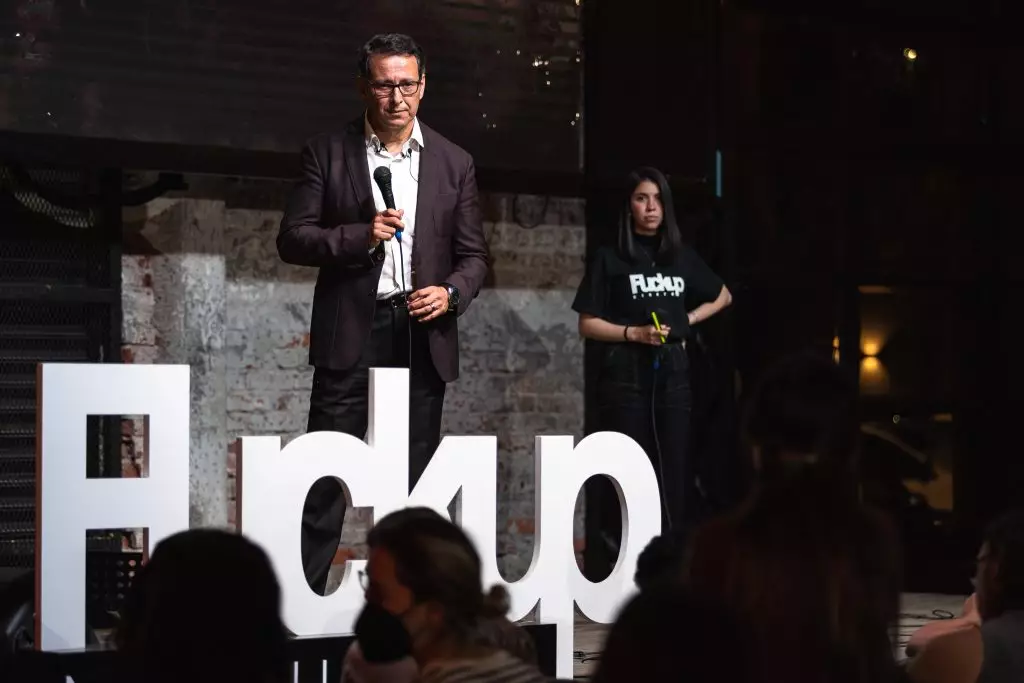
You read that headline right—we’ve officially “made it.” Fuckup Nights was on stage at a TED Talk. And while we’re more used to, shall we say, a more inebriated audience, it was an amazing experience for our representative, Leti Gasca (Fuckup Nights ’s co-founder and an all-around amazing person). And rather than try to explain the “fail mindfully” concept, we thought we’d hear it straight from Leti herself.
From Leti Gasca, co-founder of Fuckup Nights :
I have to start with a confession: when I was invited to speak at an official TED event in New York , I thought it would be easier. I had already spent several years reflecting on the topic of failure, and (having taken theater classes for years) I’d always felt very comfortable speaking in public, so I thought it would be easy and painless. However, it turned out to be more difficult than I could have imagined—and also much more instructive.
TED’s official coaches know what they’re doing. As a first step, they asked me to send them a written draft of what I wanted to say at the event, so I got to work—and spent an entire afternoon writing my talk.
I submitted it, and the feedback was devastating: the idea I had proposed wasn't new, it wasn't worth sharing, and if I really wanted to participate in TED, I had to come up with something radically innovative.
For several days, many ideas came to mind, only to be discarded because they weren't original—until one day, during my daily mindfulness practice, the pieces finally fell into place, and everything became clear.
My great idea was something I had already discussed with many entrepreneurs and with the Fuckup Nights team . It was something that had always been there, but I hadn't realized it was novel: the importance of failing in a mindful way, without humiliating those who fail in business.
That’s right, without humiliating them. In the past, publicly punishing unsuccessful entrepreneurs was common: If we traveled back in time to 800 BC in Greece, we would see that merchants whose businesses failed were forced to sit in the marketplace with a basket over their heads. In pre-modern Italy, business owners who failed and had outstanding debts were taken completely naked to a public square, where they had to bang their buttocks against a stone while a crowd jeered at them
In 17th-century France, businessmen who had gone bankrupt were taken to the center of the market, where the start of their bankruptcy was publicly announced. To avoid immediate imprisonment, they had to wear a green bonnet so that everyone would know they were a failure.
And on the other end of the spectrum are the modern-day Silicon Valley types or students who brag about failing fast and often—as if it were no big deal.
I think the mantra“fail fast”has a dark side. Of course, failing fast is a great way to accelerate learning and avoid wasting time; however, when we tell entrepreneurs that they must fail fast, we may promoting mediocrity. Furthermore, the culture of rapid failure can downplay the devastating consequences of a business failure in real life.
For example, when my social enterprise failed, the hardest part was going to the indigenous community and telling the artisans that the project had fallen through, and that it was my fault. It wasn't just a learning experience for me; it meant a loss of income for those women, who really needed it.
That’s why I decided to propose at TED that just as we’ve moved away from the idea of publicly shaming unsuccessful entrepreneurs, we must also move away from the idea that failing fast is always the best approach. And I decided to propose a new mantra: fail mindfully.
Remember that businesses are made up of people; they are not entities that magically appear and disappear without consequences. When a business fails, people lose their jobs or their money. And in the case of social or green businesses, communities or ecosystems suffer when the project fails.
What does it mean to fail mindfully? It means being aware of the impact of closing that business, being aware of the lessons learned, and being aware of the responsibility to share those lessons with the world.
I would like to express my deep gratitude to the TED team for helping me spread this idea, for challenging my intellect, and for pushing me out of my comfort zone.
Now that we’ve shared our failure at TED, we’d like to publicly invite them to speak at one of our events! There’s bound to be some interesting screw-ups behind such a huge organization! After all, not everything is perfect.
Co-founder of the movement Fuckup Nights and director of the Failure Institute. She is a member of the Global Shapers community that participates in the World Economic Forum. In 2015, she was named one of “Voices from 2040” by The Economist and was named Woman Entrepreneur of the Year.








.svg)

.webp)

.png)
.png)
.png)


.avif)
.avif)


.avif)


.avif)
.avif)


.avif)


