Some failures are visible. Others happen in silence.
In this story, Marcus Brown shares how the pressure to appear successful, combined with a growing mental health crisis, led him to one of the darkest moments of his life; and how it ultimately became a turning point.
Content warning: This story includes discussion of suicide and a suicide attempt.
If you are in immediate danger or thinking about harming yourself, please contact your local emergency services or a suicide and crisis support line right away. You can find local support at findahelpline.com. If possible, consider reaching out to someone you trust and staying with them while you get help.
Failure is a bruise, not a tattoo.
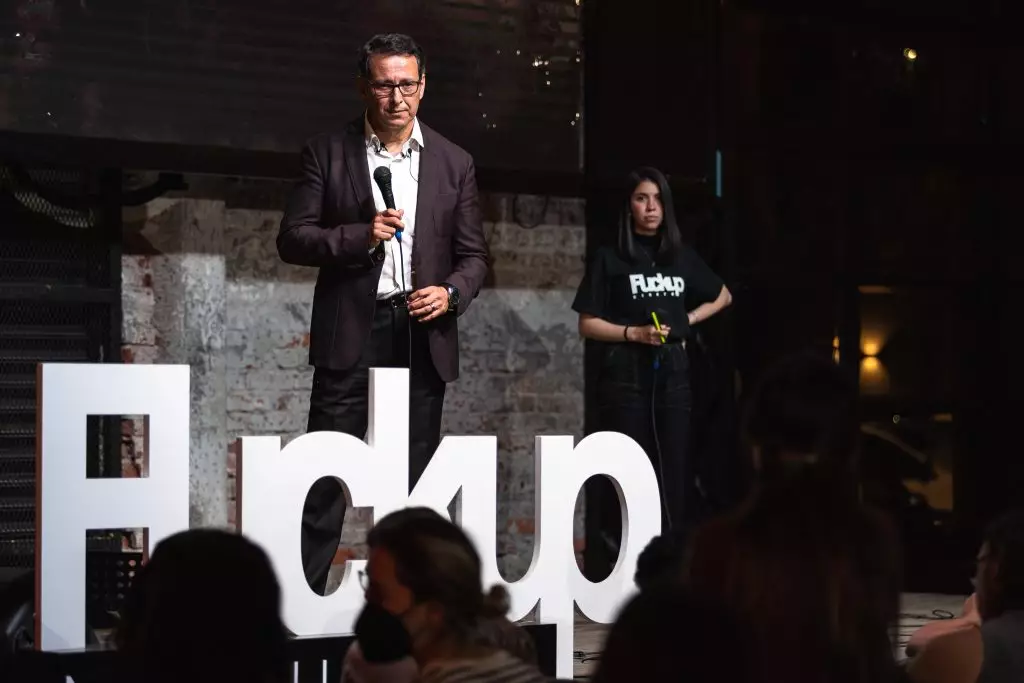
This story comes to you thanks to Fuckup Nights Munich. Don’t miss more impactful stories like this one; stay up to date on their upcoming events.
👤 Who
Marcus John Henry Brown is a speaker coach and the founder of Speakery, a speaker-coaching studio in Taufkirchen near Munich. He spent twenty years in consulting and digital advertising, latterly as a creative director. He gained international recognition as a performance artist making work about corporate culture.
Today, his purpose is to help people show the world who they really are when they present. He works with speakers on what sits underneath a talk, not just the delivery, and his own experience of burnout and depression informs every session.
FuN: What's your definition of failure?
Marcus: For me, failure is a disconnect between your truth and what you present to the outside world. Mistakes happen quickly; failure creeps.
FuN: What was your context before this story?
Marcus: At the time of my story, I was a 33-year-old business professional working in a senior position for an international firm.
The year was 2004. On the outside, I looked like a businessman: beautiful suits, the newest mobile phone. I even had hair back then! Externally, I looked like I had everything under control, but inside I struggled with the disconnect between my truth and what the job was asking of me.
Every meeting, phone call, and presentation stretched the band between who I was and what my job was asking me to do until it snapped.
I couldn’t find the words to describe what was happening. I was too embarrassed and terrified of getting found out. I was simply surviving day to day until the facade finally crumbled.
💣 The Real F*up
Marcus: I’d been asked to give an emergency presentation to a client who was furious with my employer and even angrier with me. I just couldn’t do it. I ran away. In my state of crisis, something that seems so small today became unthinkable.
I was so far gone that thoughts of suicide had started to feel like a normal part of being a senior manager in a global company.
I had reached the limit of my ability to cope with stress. The lack of a mental health culture in Germany in 2004 meant I didn’t have the vocabulary to tell anyone what was going on.
A presentation broke me. I’d rather have died than give it, so instead of going to the meeting, I headed up into the hills that surround Frankfurt.
FuN: When did you realize you had reached a breaking point?
Marcus: The exact moment happened on a deserted rural road at 3:30 a.m. on a bitterly cold winter night near Königstein.
My hire car had broken down. As the roadside assistance mechanic closed the hood and asked if everything was okay, I lied shamelessly, smiled, signed the form, and waited for him to leave.
In that silence, surrounded by snow, the Frankfurt skyline in the distance, and looking back at a gnarly old tree in the middle of a snowy field, I realised: "This time, I’ve really messed it up.”
I felt completely alone.
I’d spent three or four hours in a snowy field trying to hang myself from a tree. I tried three times and failed. Eventually, I just sat under the tree drinking a bottle of Jim Beam I had bought at a petrol station.
My family, colleagues, and friends were desperately trying to contact me. I lied to everyone. Even to the mechanic, a stranger who noticed something was wrong, I insisted I was perfectly "fine.”
If you're in immediate danger or thinking about harming yourself, contact your local emergency services or a suicide crisis hotline. Find support in your country at findahelpline.com, and if you can, reach out to someone you trust.
FuN: What happened after that night?
Marcus: Two weeks after my suicide attempt, the company fired me. It took me years, from 2005 to 2012, to process that night under the "Hanging Tree".
10.773 people took their own lives back in 2004. Today, I’m glad I wasn’t one of them. I’m not proud that I tried.
It’s a fucked up story. It’s painful. It’s a story that used to own me, but now it is mine. I own it, and I take responsibility for it.
I didn’t know it at the time; in fact, it’s taken me nearly twenty years to realise that it was the pivotal moment in my life.
I’m not a doctor. I’m not a mental health expert. I’m not a therapist. I’m just a speaker coach. But I can help.
My real purpose in life is to help people align why they get up in the morning, their job, with what they say when they stand in front of an audience with a clicker in their hand.
I want to help them understand who they truly are and find joy and optimism in all that they do, say and aspire to achieve.
Connect with Marcus!
💡 In conclusion
- Professional Help is Crucial: We are not mental health experts; in a crisis, the instruction must be to call specialists (like a suicide prevention hotline).
- Create Safe Spaces: We must be a "safe space" where others can fail without fear of consequences or shame.
- Identify Early Warning Signs: It is vital to develop "early warning" systems to notice when a colleague moves from being stressed to being "unsettled."
- Vulnerability is Strength: Sharing these stories breaks the stigma and can lead others away from their own “hanging tree.”








.png)



.svg)

.webp)


.png)
.png)
.png)

.png)

.png)
.png)

.png)
.png)
.png)
.webp)
.png)

.png)
.png)

.png)
.png)
%20(1).png)


.avif)

