The 12 Business Model Types
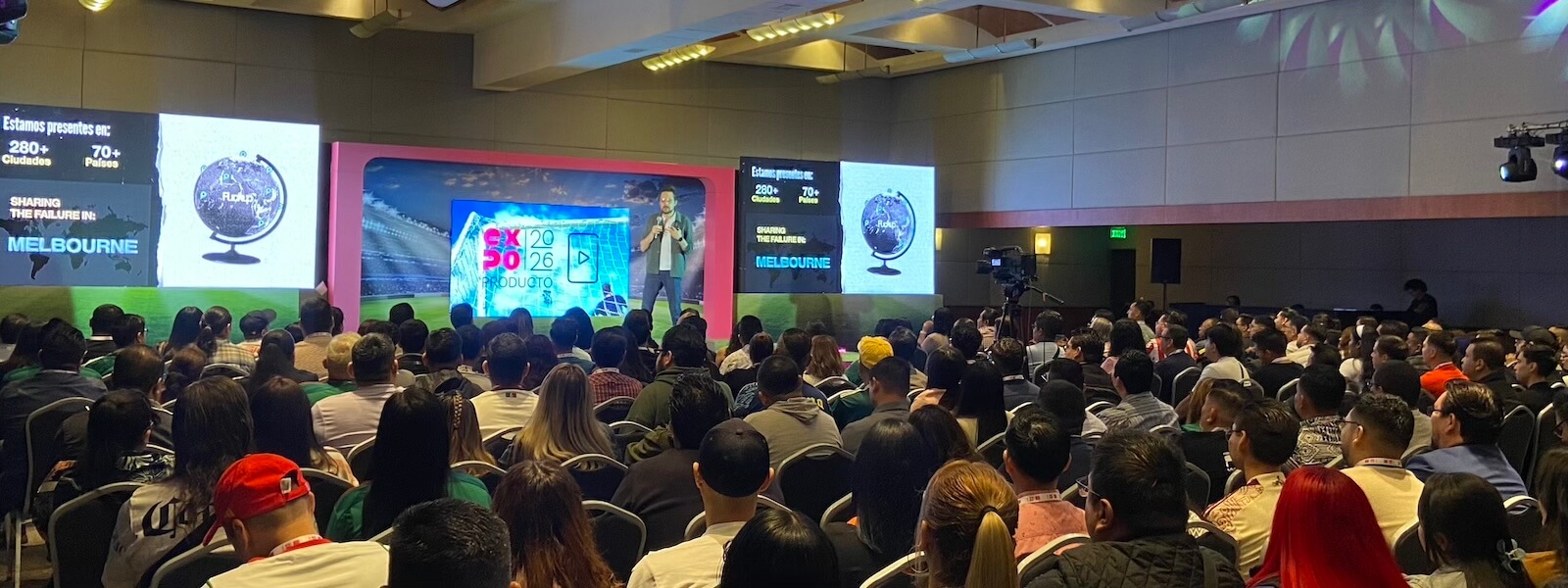
Pepe Villatoro, Co-founder and CEO of Fuckup Nights, opened the workshop with one question: how many of the 12 existing business model types have you seriously considered for your company?
Most were running on one or two. The full map — subscription, licensing, platform, SaaS, outcome-based, freemium, asset arbitrage, ecosystem, community, data — wasn't familiar territory.
The problem isn't not knowing them. The problem is never examining them in a structured, disciplined way. And most of the time, it's failure — or the threat of it — that finally forces you to open that map.
Rolls-Royce stopped selling engines and started selling flight hours. Deel turned regulatory friction into a global SaaS compliance product. Neither of these are startup stories. They're stories of companies that decided to redesign the core question: how do I capture value?
Flywheels and Exponential Organizations: What Separates a Profitable Model from a Strategic One
Knowing the model types is step one. Step two is making them hard to copy.
That's where the flywheel came in — self-reinforcing cycles where each element drives the next. Amazon uses one. So does Fuckup Nights: more events build more community, more community attracts more companies, more companies fund more events.
A well-designed flywheel is almost impossible to replicate. Not because it's secret, but because it takes years to build.
The workshop also introduced Salim Ismail’s Exponential Organizations (ExOs) framework: companies that grow 10x faster without needing 10x more resources. Applied not to Silicon Valley startups, but to a construction firm in Michoacán or an agro-industrial business in the Bajío region.
The practical question on every table: what part of your current operation, if you accelerate it, could set everything else in motion?
When Business Owners Sit Down to Talk About Failure
On day two, attendees worked through real cases of business models that failed — and companies that reinvented themselves as a result.
Yahoo turned down the chance to buy Google for $1 million in 1998. Sixteen years later, Yahoo sold to Verizon for $4.8 billion.
The point wasn't the numbers. It was this: the most expensive failure isn't the mistake you make. It's the right decision you never took.
The 5 Levers to Innovate a Business Model: From Theory to Your Own Hypothesis
The Brain Trust was the most honest moment of the workshop. Four or five people looking at a colleague's business model and asking the most uncomfortable questions they could think of.
The 5 levers block — customer segment, value proposition, channel, revenue stream, cost structure and assets — let each table work on a real company in the room. Not a hypothetical. Their company. With its underused assets and assumptions that hadn't been questioned in years.
That's exactly what Fuckup Nights has been doing with organizations in 100+ countries for over a decade: creating safe spaces where hard questions are allowed, and where failure — or the threat of it — becomes the starting point for something better.
What This Workshop Made Clear About Business Model Innovation
Not every company needs to become a digital platform. Not everyone needs to scale globally or adopt AI in the next six months.
But every company has unquestioned assumptions. Inherited models. Potential flywheels no one has noticed yet.
What this workshop proved — with real business owners from traditional industries in the heart of Mexico — is that business model innovation isn't a startup privilege. It's available to anyone willing to ask the right questions.
"The most dangerous business model doesn't exist yet. Someone is designing it right now. Are you going to wait for it — or build it yourself?"
If your company is ready to ask that question — and work through it with a team that's led this conversation with leaders across five continents — here’s how we do it.











.svg)

.webp)


.png)

.png)
.webp)

.jpg)



.jpg)
.jpg)
.jpg)



.jpg)
%20(1).jpg)

%20(1).jpg)
%20(1).png)
%20(1).jpg)
%20(1).jpg)
.jpg)
%20(1).jpg)


.jpg)
