When 9 a.m. rolls around, we must become non-sentient beings
Did you know that 40% of employees believe that leading a project that doesn’t go as planned has a negative impact on people?*
Our "Fear of Failure" workshop challenges the notion that, come 9 a.m., we must become mindless beings focused solely on productivity.
Here's what you can expect from our workshop on the Fear of Failure
- Talking about fears and insecurities
During the workshop, we try to make sense of all the emotions that come with failure. Because, more often than not, the mere possibility of failure paralyzes us, preventing us from bringing that great idea we came up with to life.
Fear is a basic emotion and helps keep us alive. However, as we explain in the workshop, imaginary fears that dominate our thoughts cause us to live a life that seems full of obstacles.
When we talk about the fear of failure, we’re talking about businesses, ideas, or projects that get bogged down in“what if” scenarios. In a professional setting, we face the fear of jeopardizing our professionalism, our reputation, or our credibility if things don’t go as planned. We don’t want to let our colleagues or bosses down; we understand that there are expectations placed on us, and the thought of not meeting them terrifies us.
- Speaking of vulnerability... and being vulnerable
We have come to realize the importance of creating safe spaces where people can be vulnerable. Talking about fear in the workplace means showing vulnerability —and that’s something we’re not used to doing. Although there has been a surge in interest in “mental health at work” in recent years, it’s still difficult to openly share our emotions with our colleagues or bosses.
- Talking about shame and blame
Shame and guilt may seem similar, but they are not the same. During the workshop, we explore the differences between them and offer insights on how to manage those feelings.
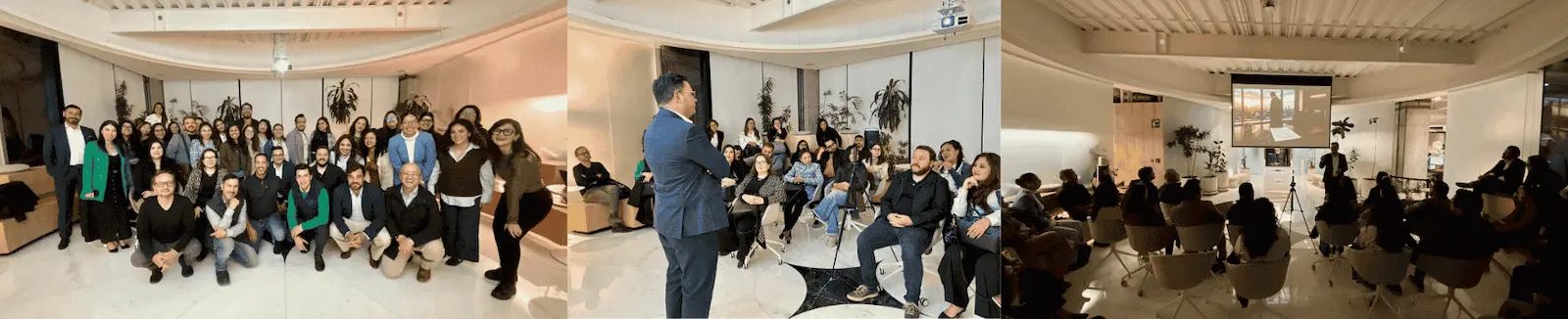
The closing activity is called “Share the Failure.” It involves sharing a story about a failure in small groups of three or four people. In this case, the story must relate to feelings of fear, shame, guilt, or any other negative emotion caused by the failure.
What we aim to evoke through this dynamic is a sense of liberation, camaraderie, empathy, and mutual support. We take off our masks to realize that we are all the same and feel the same way.
The goal is also to find ways to manage our fear of failure and to discuss some tools that can help us work more effectively with team s in a simple and immediate way.
In what cases is our workshop on Fear of Failure not a good fit for your team or organization?
- You're looking for a quick solution
We are offering this workshop as the first in a series of five:
- Fear of Failure
- Psychological safety and vulnerability
- Dealing with failure
- Communication and difficult conversations
- Innovation
The reason we recommend that the Fear of Failure workshop be the first one is that it addresses a fundamental issue: the root of this fear. This means it is only the first step toward building a culture of failure based on initiatives that aim to achieve tangible results in the short, medium, and long term.
These results relate to productivity metrics, talent retention, employee well-being, as well as employee engagement and commitment, and employee turnover.
However, just like all our workshops, we tackle sensitive topics here. Which brings us to another situation where this workshop might not be the best fit for your company:
- The emotional side of work life is not given much attention in your organization
Talking about our feelings or the things we’re afraid of can lead to rejection, and people may choose may to open up during group activities.
Creating this space is the first step toward fostering a cultural shift within your organization. It is a safe space where people have complete freedom to propose ideas, test them, fail, and share their experiences—all without fear, shame, or guilt. This will benefit the company by helping employees feel happier and, as a result, become more productive.
The "Fear of Failure" workshop is also part of The Failure Program, our data-driven and solution-oriented suite of services for organizations that want to harness the power of failure by embracing the vulnerability, authenticity, and freedom that come from accepting something as natural and human as fear.
Please fill out this form and let’s work together to bring this or other workshops to your company.
*Source: Failure Survey 2021–2022








.svg)

.webp)

.png)
.png)
%20(1).png)
%20(1).png)
.png)
.png)


.avif)

.avif)
.avif)


.avif)


.avif)


.avif)


.avif)
.avif)


.avif)


.avif)


